
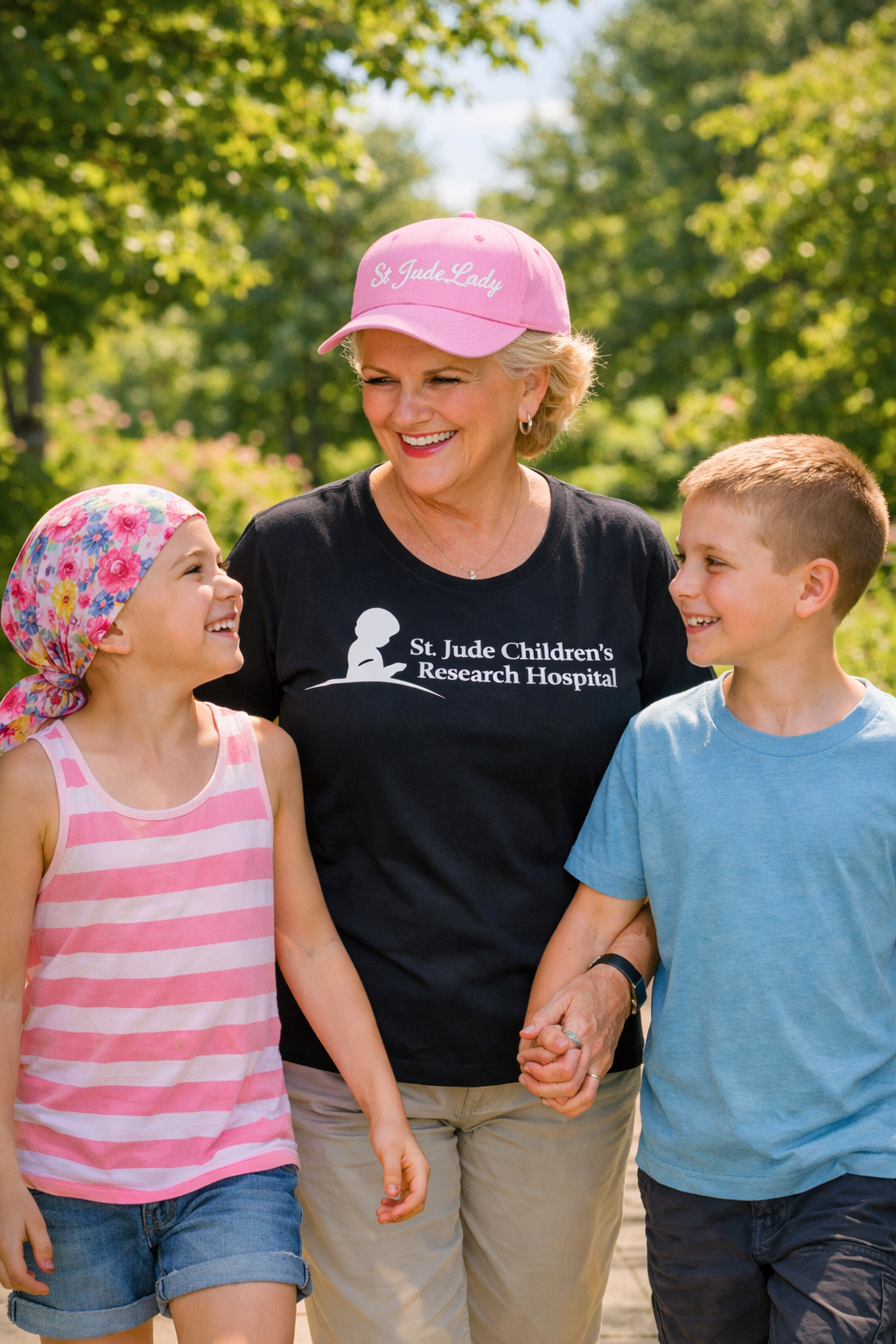
So Your Baby Has Cancer
"From "Becoming the St. Jude Lady 2.0":
So Your Baby Has Cancer: What Do You Do?
I. The Moment the World Tilts
There are moments in life that divide everything into Before and After. The day you hear the words your child has cancer is one of them.
It doesn’t matter how old your child is — a newborn, a toddler, a teenager — the word cancer hits the same way. It is a word that does not belong in the same sentence as baby, and yet there it is, spoken by a doctor who has said it too many times and still hasn’t found a gentle way to deliver it.
The room changes shape. The air thickens. Your own heartbeat becomes something you can hear in your ears.
You try to listen, but your mind is already running ahead, sprinting into the dark, imagining every terrible possibility. You try to stay present, but your body feels like it’s floating above the chair, watching someone else receive the news.
You think: This cannot be happening. You think: There must be a mistake. You think: What do I do now?
And then, slowly, the truth settles in. Your baby has cancer. And you have to find a way to keep breathing.
II. The First Hours: Shock, Silence, and the Strange Practicalities
The first hours after diagnosis are a blur of paperwork, phone calls, tests, and questions you never imagined asking. You move through the motions like someone underwater.
You learn new words — biopsy, protocol, staging, oncology — and you nod as if you understand them. You don’t. Not yet.
But you nod anyway because you don’t know what else to do.
You call family members, and your voice sounds like it belongs to someone else. You try to explain, but how do you explain something you haven’t processed yourself?
People cry. People gasp. People say, “Let me know what you need,” and you don’t know what you need.
You look at your child — your baby — and you wonder how you will ever be strong enough to do what comes next.
III. The Awkward Conversations
No one teaches you how to talk about childhood cancer. There is no handbook for the awkwardness.
You will have conversations where people say the wrong thing — not because they mean harm, but because they don’t know what to say.
They will say:
- “God doesn’t give you more than you can handle.”
- “Stay positive!”
- “My cousin had cancer… he didn’t make it.”
- “At least it’s not—”
- “Everything happens for a reason.”
You will smile politely, because you don’t have the energy to correct them. You will nod, because arguing feels impossible. You will go home and sit in the quiet, replaying their words, wondering why comfort sometimes feels like sandpaper.
And then there are the conversations with your child.
If your child is old enough to ask questions, they will ask them at the worst possible times — in the car, at bedtime, while you’re trying to hold yourself together.
They will ask:
- “Am I going to die?”
- “Why do I have to get shots?”
- “Will my hair fall out?”
- “Will I still be me?”
You will answer with a voice that trembles, but you will answer. You will tell them the truth, softened by love. You will tell them they are brave, even when you feel anything but.
And somehow, your child will teach you how to talk about cancer better than any adult ever could.
IV. The Long Nights
Cancer introduces you to a new kind of night — the kind where sleep is optional and fear is constant.
You lie awake listening to the hum of machines, the beep of monitors, the soft breathing of your child. You memorize every sound. You learn to distinguish between normal quiet and dangerous quiet.
You learn that exhaustion is not a feeling but a location — a place you live now.
You learn that hope is not loud. Hope is a whisper. Hope is a hand on your shoulder. Hope is the nurse who checks on you even when she’s off shift. Hope is the doctor who says, “We have a plan.”
V. The Search for Help: How Families Find St. Jude
At some point — maybe early, maybe after a few weeks — someone mentions St. Jude.
Sometimes it’s a doctor. Sometimes it’s a nurse. Sometimes it’s another parent in the hallway who looks at you with the kind of understanding only another cancer parent can give.
They say, “Have you considered St. Jude?” And something inside you shifts.
You’ve heard the name before — maybe from a commercial, maybe from a fundraiser, maybe from a song. But now it means something different. Now it feels like a lifeline.
You ask questions. You make calls. You send medical records. You wait.
And then, one day, you get the call: St. Jude will take your child.
You cry — not because the fear is gone, but because the fear finally has somewhere to go.
VI. The Journey to Memphis
Traveling to St. Jude is not like traveling anywhere else. You pack bags you never wanted to pack. You bring comfort items — blankets, stuffed animals, favorite books. You bring paperwork, medications, and a heart full of dread.
You arrive in Memphis and feel something you didn’t expect: relief.
The campus is bright, colorful, alive. It feels like a place built for children — not for sickness, but for hope.
You walk through the doors and see murals, toys, smiling staff, and families who look like you — tired, scared, determined.
You think: Maybe we can survive this.
VII. The Cost — Or the Miracle of No
Cost
One of the first things you learn at St. Jude is the thing people talk about the most:
You will never receive a bill.
Not for treatment. Not for housing. Not for food. Not for travel. Not for anything.
You don’t understand it at first. You ask again, just to be sure. You wait for the fine print.
There is none.
St. Jude removes the financial terror so you can focus on your child. It is the closest thing to a miracle you will ever experience in a hospital.
VIII. Life Inside St. Jude
Days at St. Jude have a rhythm — not a normal rhythm, but a survivable one.
You wake early. You go to labs. You meet with doctors who know your child’s case better than you do. You learn to read charts, numbers, scans. You learn to celebrate small victories — a good blood count, a stable scan, a day without nausea.
You meet other parents in waiting rooms. You share stories, fears, jokes that only make sense inside these walls. You become family without ever planning to.
Your child makes friends — friendships forged in the fire of shared struggle. They play together between treatments. They laugh in hallways. They show you what resilience looks like.
You learn that St. Jude is not just a hospital. It is a community. It is a refuge. It is a place where fear loosens its grip.
IX. The Emotional Landscape
Cancer is not one emotion — it is all of them.
You feel:
- Fear
- Anger
- Guilt
- Hope
- Exhaustion
- Gratitude
- Loneliness
- Strength you didn’t know you had
You learn that courage is not loud. Courage is showing up. Courage is signing the consent form. Courage is holding your child’s hand during chemo. Courage is crying in the bathroom and then walking back out with a smile.
You learn that love is a force stronger than fear.
X. The Awkwardness of Returning Home
When treatment stabilizes and you return home — even temporarily — you discover a new kind of awkwardness.
People don’t know how to act around you. Some avoid you because they’re afraid of saying the wrong thing. Some smother you with concern. Some treat your child like glass. Some pretend nothing happened.
You learn to navigate it with grace, even when it hurts.
You learn that cancer changes your social world as much as your medical world.
- The Child’s Perspective
Children understand more than adults think.
They notice:
- The way you watch them
- The way you hide your tears
- The way you whisper with doctors
- The way you flinch at fevers
They ask questions that break your heart. They make jokes that save it.
They teach you how to be brave.
- The Survivors’ Circle
Eventually — slowly, painfully, miraculously — you reach a place where the word survivor enters the conversation.
It is not a finish line. It is not a guarantee. It is not an erasure of what happened.
It is a new chapter.
You join a community of parents and children who have walked through fire and come out carrying light.
You learn that survival is not just living — it is remembering, honoring, and helping others find the path you once searched for in the dark.
XIII. What You Do Next
You tell your story. You help other families. You raise money. You build community. You become part of something larger than yourself.
You discover that the journey you never wanted has become the mission you were meant to carry.
You learn that hope is not a feeling — it is an action.
And you take that action every day.
XIV. Final Reflection
So your baby has cancer. What do you do?
You love them. You fight for them. You walk into St. Jude and let the light in. You hold onto hope with both hands. You join the survivors — not because the journey was easy, but because you refused to stop walking.
And you discover, in the quiet moments, that you are stronger than you ever imagined.